
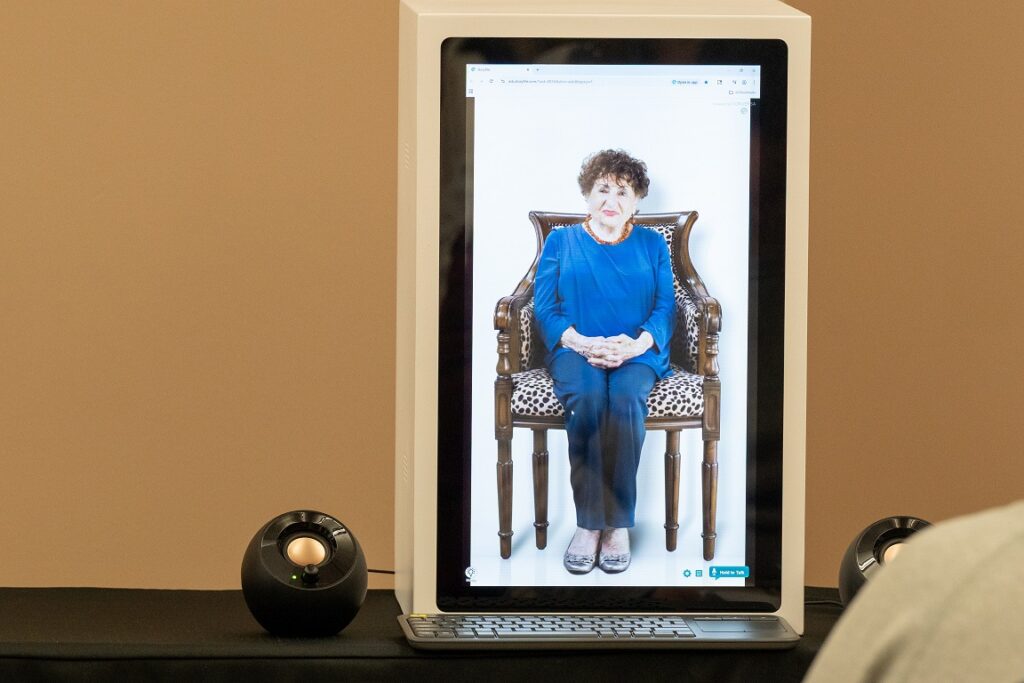
Capitalizing on the latest technology, the Middlesex College Holocaust and Human Rights Center (HHRC) hosted “The Next Dimension in Storytelling,” a powerful event that featured a Q&A from Holocaust survivor Sonia Warshawski—via hologram.
“The lessons of history can be turned into beautiful vibrant tools, whether films or holograms, for empathy and social justice,” said Middlesex College History Professor and HHRC Director Terrence Corrigan.
The interactive AI-generated hologram was created by the Innovative Holocaust Education Program from The Blue Card, an organization that provides support to Holocaust survivors.
“Innovations like the Interactive Holocaust Education Program expand what we ever thought was possible in the way of teaching and learning human experiences,” said Middlesex College President Mark McCormick. “By utilizing hologram technology, we can continue to connect with future generations so as to not repeat the past.”
The event began with the screening of a short film detailing the life of Warshawski working as a tailor in suburban Kansas City and the efforts made by her family to keep her story alive. The 45-minute film Big Sonia depicted Warshawski being interviewed by NPR, local schools, and even prison inmates.
Warshawski, who lived in Poland, survived stays in three different concentration camps before and during World War II, losing her entire family in the process. She survived with her only relics, a tattered scarf from her mother and a tattoo on her left arm.
“The part with her mother’s scarf was particularly moving,” said Corrigan. “The film proves that storytelling is the most effective way to ensure history remains a living dialogue rather than a closed book.”
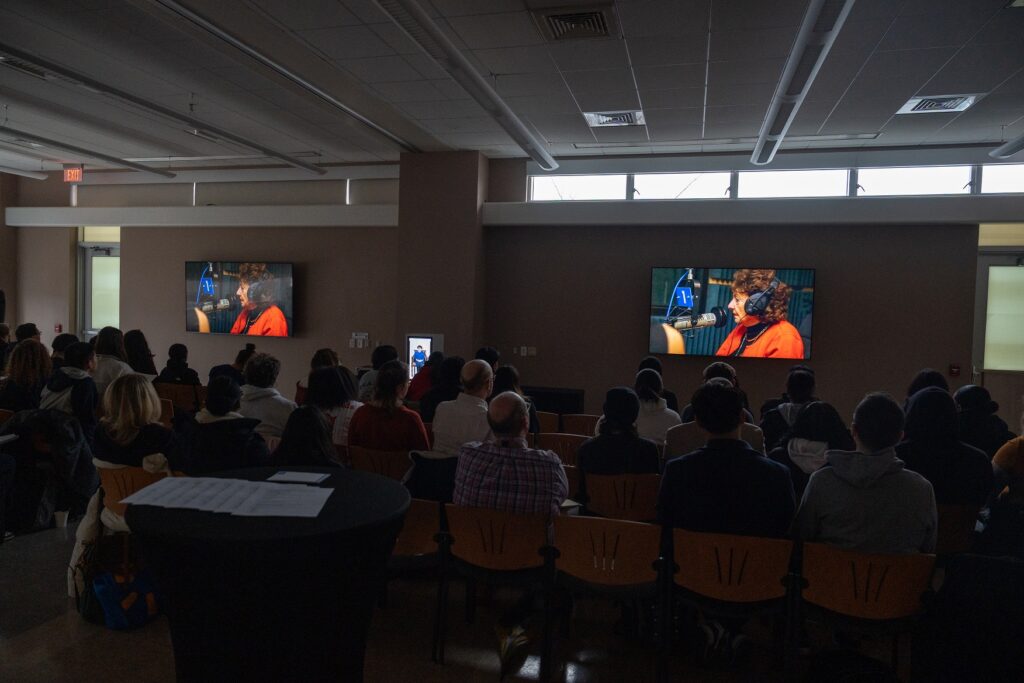
After the film screening, there was an opportunity to ask Warshawski’s hologram questions about her experience thanks to technology provided by the Blue Card Foundation’s Innovative Holocaust Education Program. The hologram is pre-programmed with answers while capturing Warshawski’s personality and grace.
The audience included Middlesex College students as well as leadership from the Jewish Community Center of Middlesex County, Provident Bank, the Jewish Federation in the Heart of New Jersey, and the New Jersey Council of County Colleges (NJCCC).
“The video was incredibly powerful,” said Linda Scherr, chief academic officer of NJCCC. “Hearing it and the context of what is happening politically in the United States now came across differently to me. I also noted how the students were locked in. That doesn’t happen all the time.”
By utilizing cutting-edge technology like a hologram, the hope is to draw in a new generation of learners to hear stories of the Holocaust from survivors like Sonia. The Blue Card group is an organization devoted to keeping the stories alive and believes there are only 250,000 survivors left in the world.
“It’s important to keep Sonia’s story alive because individual memories provide an empathetic record of the human condition,” said Corrigan. “They transform historical events into human experiences.”
