
Brookdale’s Civility Week program centered on a timely question: in an era of escalating polarization, how do we stay human with one another, especially when the conversation gets hard?
Keynote spotlight: Dr. Kirk J. Schneider
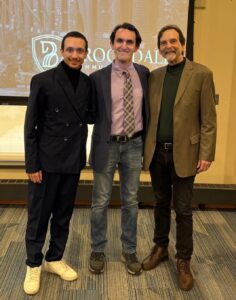 The week’s featured keynote, Dr. Kirk J. Schneider, brought a deeply human lens to the topic of civility. A licensed psychologist and leading voice in existential-humanistic psychology, Schneider explored how anxiety and uncertainty often fueled the “polarized mind,” a narrowing into rigid, one-sided thinking that made it easier to label people than understand them.
Drawing from his work on “life-enhancing anxiety,” Schneider argued that the antidote to destructive anxiety wasn’t avoidance or forceful certainty, but the capacity to tolerate complexity, stay grounded while remaining open to discovery, nuance, and the uncomfortable truth that more than one perspective could hold pieces of reality.
A program designed to be practiced, not just heard.
Instead of a keynote-only event, Brookdale’s Civility Week program unfolded as an experience moving from ideas to action.
1) Opening remarks and introduction
Brookdale psychology professor Dr. Eugene DeRobertis introduced Schneider and shared personal reflections on how Schneider’s scholarship and voice had shaped his own professional path. His remarks framed the morning as both academic and personal, emphasizing meaning, responsibility, and authentic encounter, especially at a moment when many people felt overwhelmed by division.
2) Learning the method: Experiential Democracy Dialogue (EDD)
Schneider then introduced Experiential Democracy Dialogue (EDD), a structured dialogue process he had developed over decades to help people with opposing views discuss controversial topics with greater care. He outlined clear ground rules, including monitoring nonverbal reactions, speaking from personal experience, and replacing “gotcha” questions with genuine curiosity.
3) Live demonstration with Brookdale alumni
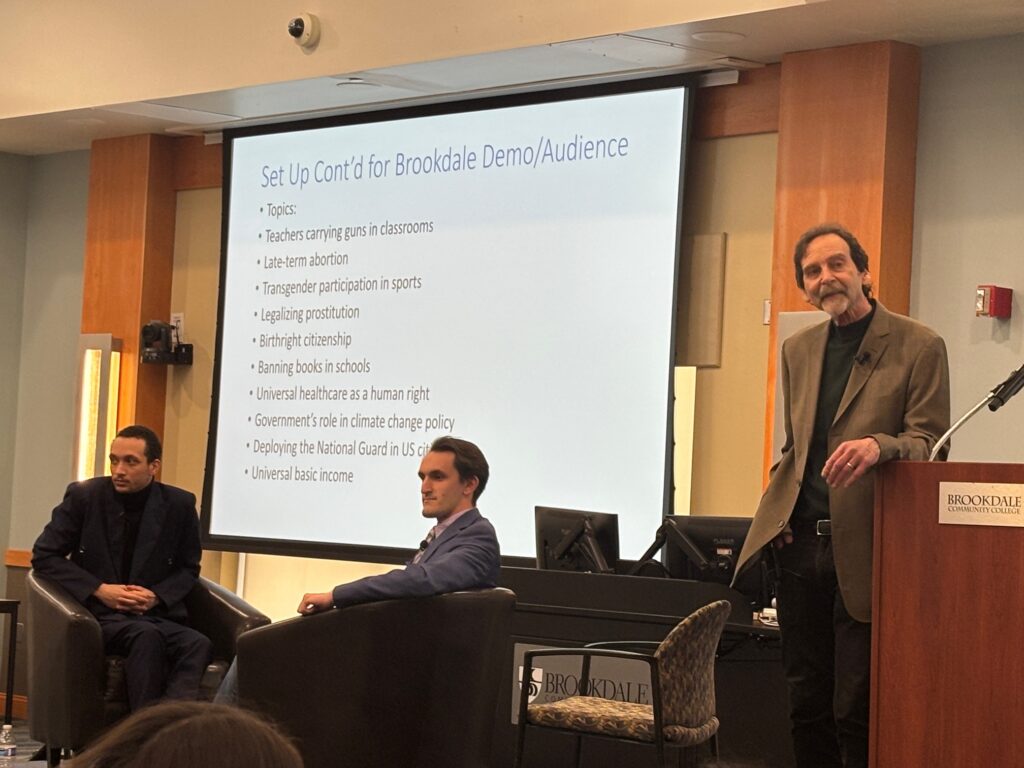
The program then shifted to a live demonstration, featuring two Brookdale alumni: Dominic Sama and Montez Swartz. Facilitated by Schneider, the pair modeled the EDD process on stage, using universal basic income as their discussion topic.
Rather than debating, they shared formative experiences that shaped their views on family history, work, public service, economic insecurity, and the future of jobs in an AI-driven world. As the dialogue progressed, they identified stereotypes attached to their positions, named what felt unfair, and searched for common ground, including shared concern about how emerging technologies were reshaping opportunity.
4) Audience Q&A and reflection
During the Q&A, participants named what felt difficult about watching (and imagining themselves in) civil disagreement, from generational norms about avoiding politics to the fear of saying the wrong thing in a world where every comment could be recorded and replayed without context.
Schneider and others pointed to warning signs that dialogue was breaking down when people spoke only in talking points, refused to reflect, or couldn’t access personal experience. They also offered practical interventions: pausing before responding, reflecting back what you heard, asking permission to share your perspective, and setting ground rules before sensitive conversations.
5) Practice session
Finally, the program invited the audience to participate directly, pairing up to practice the EDD technique themselves, reinforcing the central message of Civility Week: civility wasn’t passive or performative. It was a skill that improved with structure, intention, and practice.
Why it mattered
By the end of the session, Civility Week didn’t just ask people to “be nicer.” It challenged the community to build capacity to slow down, stay curious, and hold disagreement without collapsing into contempt. And it modeled what was possible when people chose to meet one another as full human beings, not positions.