
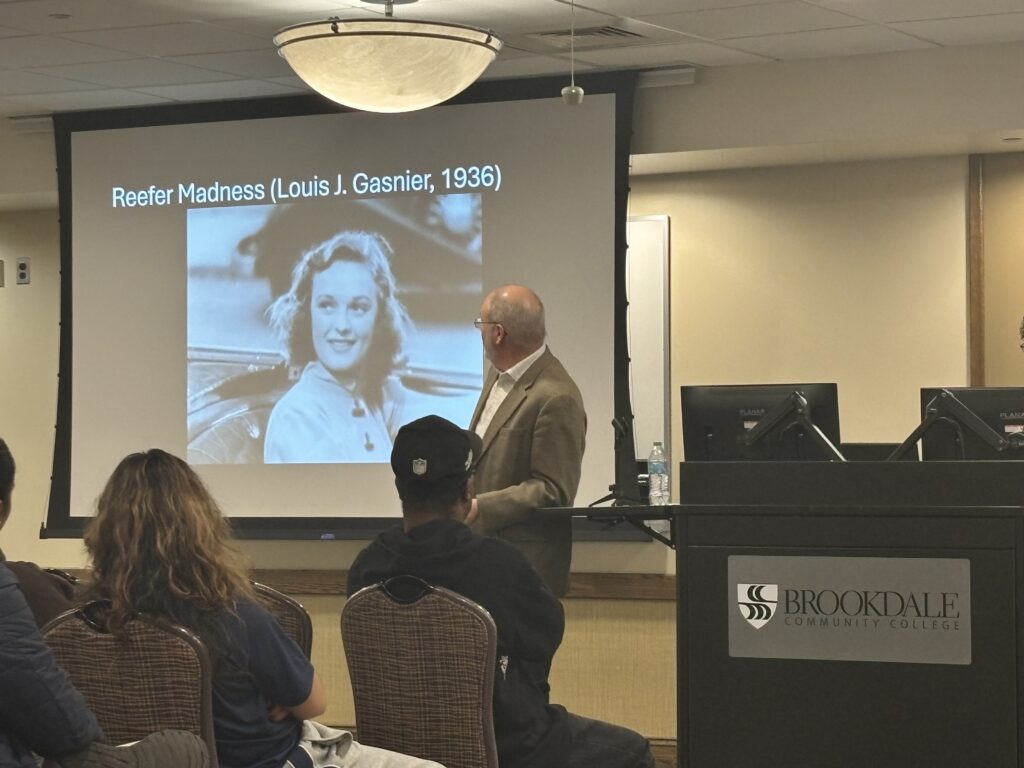
As part of Brookdale’s Civility Week programming, a cross-campus panel invited students, faculty, and staff to take a closer look at how film has long shaped public opinion, reinforced ideology, and influenced the way people understand the world.
The session, titled “Real Influence: Propaganda in Cinema,” was introduced by Georgia Cassidy, assistant professor of Nursing and liaison, Global Citizenship Project, who welcomed attendees and framed the discussion within the broader Civility Week theme, “Democracy Takes Courage.” Cassidy noted that film plays a powerful role in shaping how people see themselves, one another, and society, making media literacy an essential part of civic engagement.
The presentation featured Jonathan Shaloum, director of the Teaching and Learning Center and adjunct professor of communication, and Dr. William Burns, associate vice president of Educational Access and Innovation, whose scholarship includes German film of the pre-World War II era. Together, they guided the audience through a thought-provoking examination of propaganda in both documentary and narrative filmmaking.
The presenters began by distinguishing persuasion from propaganda. Persuasive media, they explained, invite dialogue, present evidence, and treat audiences as critical thinkers. Propaganda, by contrast, often offers a single, non-negotiable point of view, relies on emotional manipulation, simplifies complex issues, and can distort or omit facts in service of a larger agenda.
From there, the discussion ranged across a wide range of examples from film history. Among them was Leni Riefenstahl’s Triumph of the Will, examined as a landmark in filmmaking technique and a stark example of how imagery can be used to glorify power and shape national identity. The presenters also discussed the American response through Frank Capra’s Why We Fight series, exploring how even films created to support what many would view as a just cause can still function as propaganda.
The session also looked at films such as Reefer Madness, The Birth of a Nation, Battleship Potemkin, Casablanca, wartime Disney and Warner Bros. cartoons, The Green Berets, and Red Dawn. Each example illustrated different ways film has been used to simplify political and social conflicts, create heroes and villains, stir patriotic emotion, or influence public attitudes during moments of uncertainty and upheaval.
Throughout the presentation, Shaloum and Burns encouraged attendees to think beyond entertainment value and ask deeper questions about what a film is doing beneath the surface. Who created it? What message is it advancing? What facts are being emphasized, ignored, or reframed? And how does style itself, music, narration, editing, close-ups, and imagery shape what viewers feel and believe?
The conversation also extended into the present day, as audience members raised questions about artificial intelligence, social media algorithms, streaming platforms, and the growing difficulty of distinguishing fact from manipulation in digital spaces. The presenters stressed that the same skills needed to interpret historical propaganda remain essential now: skepticism, context, research, and critical thinking.
By the end of the session, attendees were left with more than a history lesson. They were reminded that in an age of constant media exposure, civility and democracy both depend on the ability to question what we see, think independently, and engage with information thoughtfully rather than passively.